


Westpack's DNA
Premium packaging for jewelry, watches and eyewear - since 1953
Westpack develops, markets and sells quality packaging and accessories for the jewelry, watch and eyewear industry. Always keeping the customer in mind, we create long-term relationships by working persistently towards meeting the customer needs. We perform better today than we did yesterday. We do this, because we aim to be Europe’s preferred supplier of packaging and accessories for the jewelry, watch, and eyewear trade.
Our DNA and values
The Westpack DNA
We have been producing and selling packaging for the jewelry and watch industry for more than 70 years. Both nationally and internationally, Westpack's products and services are highly respected.
Although we are a B2B company, we operate with open prices on our online store. We also send you samples on most of our products. It is just our way of doing things.
Here are some additional reasons to do business with us:
- We have a wide selection of quality products at great prices. Our customer service is second-to-none, and take pride in providing detailed guidance.
- We offer fast delivery, low start-up costs and low minimum orders.
- We have a fantastic online store with 11 supported languages. But if you need to talk about product development and logo printing, our multilingual sales department is ready to take your calls or answer your emails and chat messages.
- Today, we handle 200,000 boxes and bags daily, which are shipped to more than 30,000 retail customers and jewelry manufacturers around the world.
- We are constantly developing new and exciting products.
The becoming of corporate culture
All living things come into the world with a fixed set of DNA. Corporations do not. It takes time before a company culture is established. It takes experiences (both ups and downs) before a corporation develops a unique approach to doing business.
Only with time new dynamics can be discovered, and new ideas take shape. If a company is strong enough to stand the test of time, these ideas slowly crystalize into a proven business philosophy. And if the business is successful enough, a legacy is formed. When we say that there is such a thing as a Westpack DNA, this is exactly what we are talking about: something that encapsulates – all at the same time – corporate history, legacy and philosophy.
SUSTAINABLE MATERIALS
AND PRODUCTION METHODS
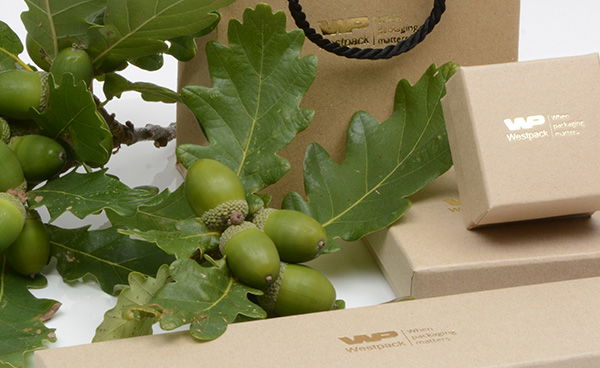
Westpack works continuously on providing as large a selection as possible of materials that are environmentally friendly. In order to make our environmentally friendly products easier to spot on our website, we have created a separate label for these products: ECO.
DOCUMENTING OUR
CSR EFFORTS AND RESULTS
As confirmed by Westpack’s values, CSR, responsibility and credibility have high priority in our organization. And since CSR is a point of emphasis for many of our partners, it is also one of our absolute field of focus. Read more about the CSR initiatives we have already made and which ones we are planning to make in our annual CSR report.
History of Westpack
Late 1930s
Valdemar Mogensen founds Holstebro Papæskefabrik (now known as ‘Holstebro Kartonnage’). Here Valdemar develops packaging for the local companies in western Jutland – for example strawberry boxes.
Late 1940s
Christen Peter Mogensen (Valdemar Mogensen’s son) joins Holstebro Papæskefabrik. In his spare time, he begins manufacturing cardboard party lamps – quite a popular thing at the time – at the attic of Holstebro Papæskefabrik with his wife Inga.
Early 1950s
At some point, C.P. Mogensen is contacted by the local watch wholesaler O.K. Jensen. He recommends Mogensen to start up a production of packaging for the watch and jewelry industry. Mogensen wisely follows the advice.
1953
The original one-man company Westpap was founded by Christen Peter Mogensen on June 18, 1953. In the beginning, the production is situated in the attic of Holstebro Papæskefabrik.
Mid 1950’s
In the first years, Westpap exclusively manufactures boxes for silver cutlery and jewelry. All manufacturing is done by hand. At a point, it becomes too cramped in the attic, and new buildings are constructed next to Holstebro Papæskefabrik.
The yearly turnover increases continually, and still more buildings are added to the headquarter. At one point, though, market liquidity becomes too low, and the Mogensen family are forced to sell their home and move into the office buildings.
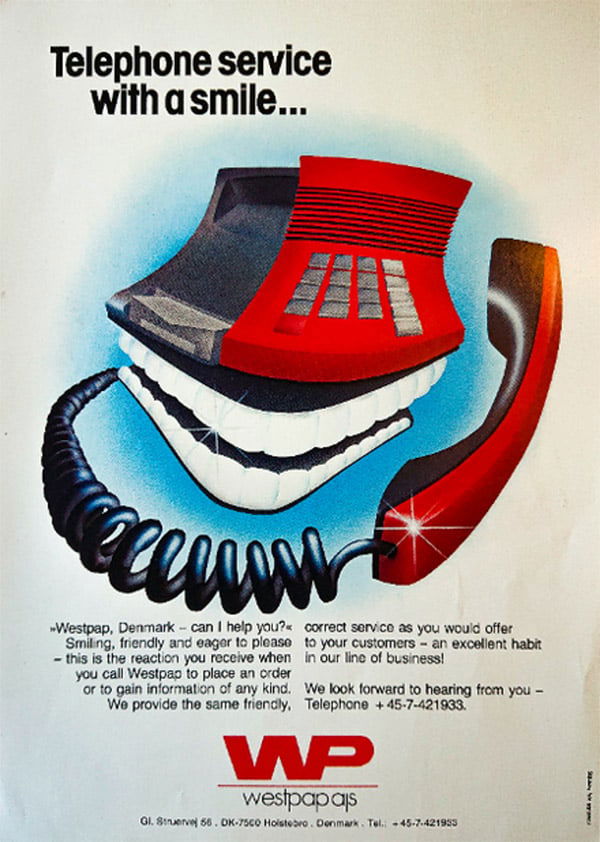
Print ad from the late 1970s